
5.26.2007
Digital Illiteracy Solved by the Masses
ars technica spotlighted a new innovation currently in the works. Remember all those countless online forms you've filled out in the past where you have to key in security word into the field? The security word is typically a stretched and skewed graphical word that appears in a box. The reason they do this is to prevent bots and spammers from creating fake accounts and/or garnering legitimate emails and personal information from the form itself. The system, in case you were wondering, is called the Completely Automated Public Turing Test to Tell Computers and Humans Apart (CAPTCHA). Now THAT'S an acronym.
Well, it would seem statistically that there are 150,000 man hours spent each day solving these little CAPTCHAs. All that work, simply to verify a form. Carnegie Mellon researchers raise the question, "What if those labor hours could be applied to something practical at the same time?" The result is a new campaign to replace the traditional CAPTCHA with reCAPTCHAs.
Instead of one word, you'll be given two. And while you do the typical form verification while filling it in, you'll also be helping a computer digitize a word that perhaps does not appear in a standard web format. Essentially you'll be helping the Internet learn to read different writings and words. This can improve the library of known words on the net and evolve the OCR (optical character recognition) apps being used across the web.
There's also some anti-spam potential and also a better way to fine-tune systems used to digitize books. Unfortunately, I was a bit unclear on that practicality. Perhaps the original blog I'm referencing would make things clearer to you.
In either case, it's exciting the possibility of using a mundane task to build up an automated computer system exponentially. The scary side, however, is that you're making OCRs that much more powerful. Hand-writing, slangs, and abbreviations will be just the beginning of what the net will be able to read. While there is some security benefits from this endeavor, it seems to me there's actually more danger. For instance, this could easily be a first step into using inconspicuous man(mind) power unbeknown to the user to evolve the intelligence of a machine, the first legitimate venture of using the masses for the betterment of artificial intelligence (AI).
Then we build robots. The robots become self-aware. The robots think they're better than us. The robots destroy most of us. We run away. The robots chase us. Oh wait, that sounds awesome. Never mind. Bring on the AI revolution!
Well, it would seem statistically that there are 150,000 man hours spent each day solving these little CAPTCHAs. All that work, simply to verify a form. Carnegie Mellon researchers raise the question, "What if those labor hours could be applied to something practical at the same time?" The result is a new campaign to replace the traditional CAPTCHA with reCAPTCHAs.
Instead of one word, you'll be given two. And while you do the typical form verification while filling it in, you'll also be helping a computer digitize a word that perhaps does not appear in a standard web format. Essentially you'll be helping the Internet learn to read different writings and words. This can improve the library of known words on the net and evolve the OCR (optical character recognition) apps being used across the web.
There's also some anti-spam potential and also a better way to fine-tune systems used to digitize books. Unfortunately, I was a bit unclear on that practicality. Perhaps the original blog I'm referencing would make things clearer to you.
In either case, it's exciting the possibility of using a mundane task to build up an automated computer system exponentially. The scary side, however, is that you're making OCRs that much more powerful. Hand-writing, slangs, and abbreviations will be just the beginning of what the net will be able to read. While there is some security benefits from this endeavor, it seems to me there's actually more danger. For instance, this could easily be a first step into using inconspicuous man(mind) power unbeknown to the user to evolve the intelligence of a machine, the first legitimate venture of using the masses for the betterment of artificial intelligence (AI).
Then we build robots. The robots become self-aware. The robots think they're better than us. The robots destroy most of us. We run away. The robots chase us. Oh wait, that sounds awesome. Never mind. Bring on the AI revolution!
Labels: AI, Internet, OCR, spam, technology
5.25.2007
Pandora's Foxy
Decided to do some massive MapQuesting before I head out to Seattle this Tuesday. Since I'm far from my iTunes, I thought perhaps I would check out whatever became of Pandora.com. Lo and behold, it's received a massive face lift! She's hot, really hot.
If you're not familiar with the site, I HIGHLY suggest you give it a spin. It was started by a Stanford graduate as part of a technological venture called the Music Genome Project.
One of the results of the research project was pandora.com. It's a site that houses thousands of songs that users can rate according to the 400 attributes created by the research effort. What's the result? A custom radio station specially tailored to your tastes. On top of that, it is, hands down, the perfect way to find new music that caters to your favorite genre styles.
I recall its original launch. The site was fairly rudimentary and had poor music selection. In addition the recommendations were completely off the wall. Thanks to a few with perseverance and love for the program, the site started to roll. Now it has a great selection, and, typically, its recommendations are perfectly tuned to what the user's hoping to hear.
There was a short while, however, that it seemed like the site would go the same way as epitonic.com (another music database site). Lack of funding and poor marketing seemed to me, at least, to be forcing the site under, as I hadn't seen any changes to the site for well over a year. Happy to say, however, upon my most recent visit today, it would seem the site's alive and well. The redesigned the package bumper to bumper, with a brand new interface that works brilliantly with the system.
The bittersweet side, however, is that the site does feature quite a few ads. Ultimately I think this is a good thing. The site is so dynamic and intuitive, I want every effort to be made to keep it around. In that same vein of efforts, they now have hardware (radios and portable devices) that can play your custom stations. Overall, I think pandora's in for a bright future.
Sorry, iTunes, but I'm going to be spending a bit more time with someone else.
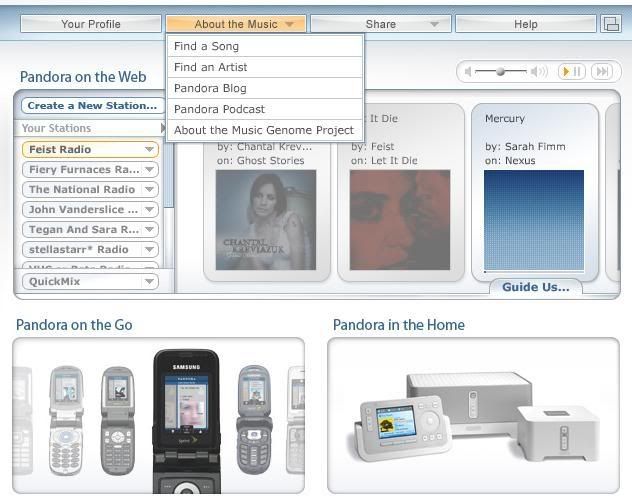
If you're not familiar with the site, I HIGHLY suggest you give it a spin. It was started by a Stanford graduate as part of a technological venture called the Music Genome Project.
"The Music Genome Project, created in January 2000, is an effort founded by Tim Westergren, a 1988 graduate from Stanford University and spearheaded by a group of musicians and technicians to 'capture the essence of music at the fundamental level' by using over 400 attributes to describe songs." (from wiki)
One of the results of the research project was pandora.com. It's a site that houses thousands of songs that users can rate according to the 400 attributes created by the research effort. What's the result? A custom radio station specially tailored to your tastes. On top of that, it is, hands down, the perfect way to find new music that caters to your favorite genre styles.
I recall its original launch. The site was fairly rudimentary and had poor music selection. In addition the recommendations were completely off the wall. Thanks to a few with perseverance and love for the program, the site started to roll. Now it has a great selection, and, typically, its recommendations are perfectly tuned to what the user's hoping to hear.
There was a short while, however, that it seemed like the site would go the same way as epitonic.com (another music database site). Lack of funding and poor marketing seemed to me, at least, to be forcing the site under, as I hadn't seen any changes to the site for well over a year. Happy to say, however, upon my most recent visit today, it would seem the site's alive and well. The redesigned the package bumper to bumper, with a brand new interface that works brilliantly with the system.
The bittersweet side, however, is that the site does feature quite a few ads. Ultimately I think this is a good thing. The site is so dynamic and intuitive, I want every effort to be made to keep it around. In that same vein of efforts, they now have hardware (radios and portable devices) that can play your custom stations. Overall, I think pandora's in for a bright future.
Sorry, iTunes, but I'm going to be spending a bit more time with someone else.
Labels: music, online application, pandora, technology, web, web2.0